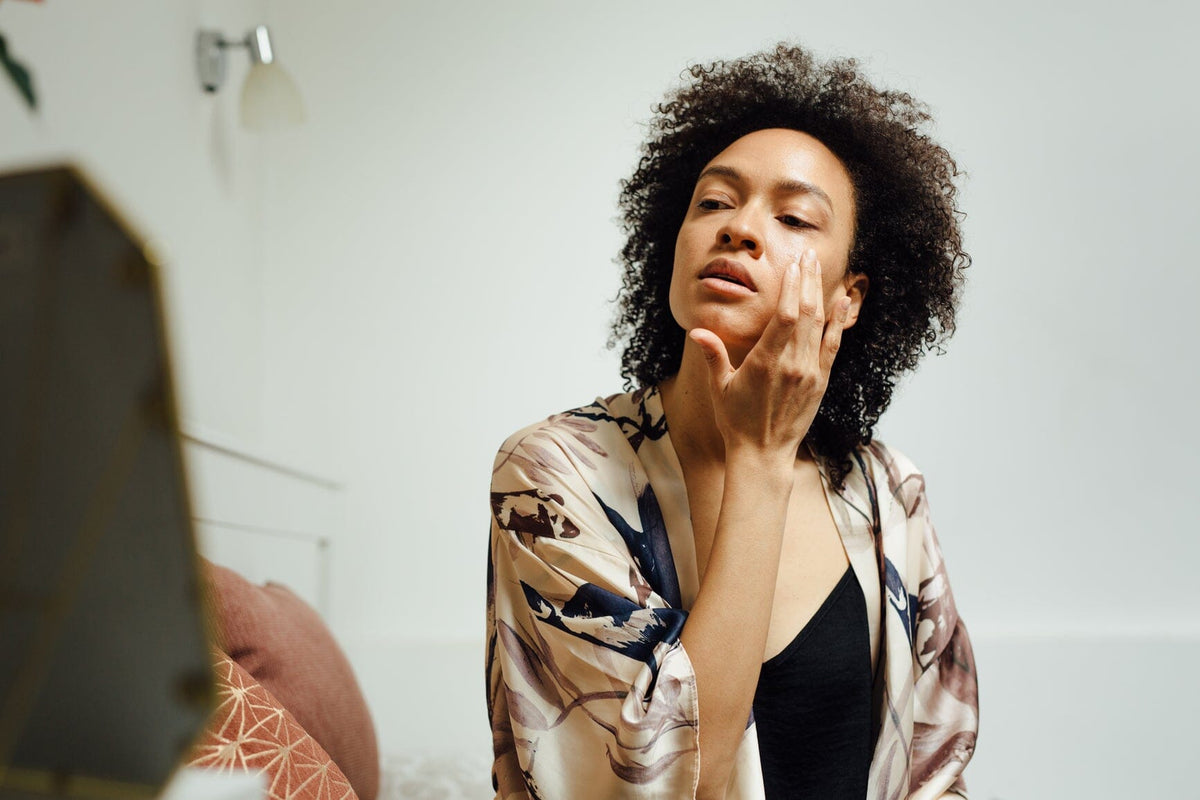

Perimenopause, defined as the years leading up to menopause, is when skin changes in women can begin to occur. And if you’ve already experienced menopause, which happens when you’ve stopped menstruating for 12 consecutive months, there's a good chance you’ve noticed and dealt with some of these significant skin transformations.
Skin changes can be challenging—especially when they’re front and center on your face—but rest assured that skin issues experienced during menopause are common, and feel confident knowing that there are ways to handle them. Here are some typical skin changes that women may experience leading up to and during menopause:1
- Dryness
- Wrinkles, fine lines, and sagging
- Acne
- Dark spots (age spots)
Skin Changes During Menopause —What’s Going On?
Two key players work together during menopause that affect the overall makeup and appearance of aging skin: collagen and estrogen.
Collagen, a protein made up of amino acids, is one of the main components of skin. These organic compounds help maintain healthy skin by constantly renewing old, damaged cells. Collagen also plays a major role in skin elasticity, helping to keep skin firm and supple and prevent it sagging.2
During the first five years of menopause, skin undergoes a radical transition where it loses about 30% of its collagen—and an additional 2% is lost each year after that. This reduction in collagen is directly tied to significant decreases in estrogen (a reproductive hormone) that occurs during menopause.3

Adopt a New Skincare Routine for Menopause
Because menopause-related skin changes can begin as early as your 40s, now may be the ideal time to consider switching up your skincare routine to help keep your skin looking and feeling good. Choosing different products and paying attention to specific ingredients (both those that should be avoided and those that should be incorporated) is more important than ever, and we're here to help with several tips to keep in mind as you consider how to care for your skin as you approach menopause.
1. Skip the Soap
If you currently use common bar soap to wash your face, consider trying a gentle, soap-free cleanser instead. Because soap strips oil from the skin, you’ll want to use a product that hydrates your skin, not one that dries it out. Look for cream cleansers rather than the foaming variety, which can dry out your skin further.4
2. Moisturize
Keep your skin hydrated with a cream-type moisturizer rather than a lotion. Lotions containing water and/or alcohol can further dry out your skin, so instead look for an oil-based moisturizer containing ceramides, glycerin, or hyaluronic acid for best results. Be sure to apply it when your skin is damp so it can be absorbed effectively and lock in moisture.5
3. Treating Menopausal Acne
We’re betting you thought your acne days were over years ago, right? Sadly, hormonal changes can cause breakouts (again) during perimenopause and menopause. Because older adult skin is very different from a teenager’s, the products you may have used when you were younger may do more harm than good now—so forget the benzoyl peroxide acne treatments and instead consider a soap-free cleanser containing salicylic acid to help unclog blocked pores. You might also consider applying a topical adapalene gel a couple times a week, as this contains beneficial retinoids.6 More about that next.
4. Pamper with Peptides and Retinols
Products with peptides (collagen-boosting amino acids) help stimulate collagen production, encouraging softer, plumper skin. Many serums and moisturizers include peptides—check ingredient lists for prefixes (di-, tri-, hexa-) or words that begin with “palmitoyl,” or end in “peptide” to verify that they are included in the product (e.g., palmitoyl oligopeptide).7 Also, applying a retinol-based cream before bedtime at least 2-3 times a week may help reduce fine lines and wrinkles, as retinol (a derivative of vitamin A) can increase collagen production.
To ensure maximum benefits from retinol creams, they should contain ingredients like hyaluronic acid, glycerin, and niacinamide to help lock in moisture and care for the outer layer of skin.8 It’s important to note that using a retinol-based cream may initially dry out your skin, but many women notice their skin adjusts after using it regularly. The key is to build tolerance slowly; to do this, leave the cream on for shorter periods of time when you begin using it. You might also skip days in between applications, giving your skin time to “rest” in between uses.9
5. Don’t Forget Sunscreen
Years of sun exposure can take a toll on your skin and result in wrinkles, fine lines, and sunspots. Protect your skin for the long haul by applying sunscreen before heading outdoors—an SPF of at least 30 or higher is recommended. In addition to preventing additional visible damage to your skin, sunscreens help reduce the risk of skin cancers.10
Skin changes in menopause can be frustrating, but there are a number of ways to treat potential dryness, wrinkles, fine lines, acne, and discoloration. Creating a new skin care routine to soothe these issues may take time, however, so just remember that a little patience will ideally help you find your new groove.
To learn more about how to support changing skin during menopause, check out our quick video on menopause skin changes, here.
Resources
- https://health.clevelandclinic.org/heres-how-menopause-affects-your-skin-and-hair/
- https://www.news-medical.net/health/What-is-Collagen.aspx
- https://www.aad.org/public/everyday-care/skin-care-secrets/anti-aging/skin-care-during-menopause
- https://www.dermstore.com/blog/different-types-of-cleansers/
- https://www.byrdie.com/menopause-skincare-4797851
- https://www.byrdie.com/menopause-skincare-4797851
- https://thegoodfaceproject.com/articles/peptides
- https://www.womenshealthmag.com/uk/beauty/skin/a35778400/menopause-skincare/
- https://www.verywellhealth.com/retin-a-drying-skin-15651
- https://www.aad.org/public/everyday-care/skin-care-secrets/anti-aging/skin-care-during-menopause







Comments
Post commentI love these info’s I read them
All , but I laugh , I’m 83 will be 84 come Valentine’s Day , wish this was available when I was the age you speak of ! How helpful it would have been , I had hysterectomy when I was 47 n took the hormone pills, so I really didn’t have the hot flashes you speak of but during my period days it was not pleasant I ended up have cyst on ovaries , fibrous uterus and endometriosis , and I was so glad to have the operation back then , but as I aged I kept taking the pill , had no issues but when I was in my late 60 my now doctor , told me to stop taking them , so now I have that dreadful dryness but the pill you recommend I take now and have been for a couple years now n it’s so helpful n I’m
Not married so it’s not for the obvious reasons it’s for my own comfort, this might seem TMI ( if u know what I mean ) but I so enjoy reading your info’s just not much on the very mature women haha ( I don’t use the O word ) but keep up the Good info ! Thanks so much ! ! If you publish this just leave off my email please !
I have now gone through menopause 3 times!
The first was with with a complete hysterectomy at age 56, but I immediately started on HRT (by patch) b/c of heart and colon cancer family genetics.
The second time was during the pandemic when I had no access to refilling my HRT patch and I went cold turkey off of hormones for 3 months—not pretty.
The third time was last summer when I was diagnosed with breast cancer, and post surgery, I suddenly had no hormones in my body at all.
I went start back into menopause again—hot flashes, night sweats, mood swings and no moisture ANYWHERE in my body. My breast surgeon’s PA suggested that I try Relizen and Revaree as I had turned into a dried up prune seemingly overnight.
I started on these products and it took a good 4 weeks to see any differnce, but once they both kicked in—it was life changing, in a very good way!!
I had to be patient, as my 68 year old self had just undergone a bilateral masdectomy assault, but these products work just fine on me, Thank you!