
Standing in front of a stocked shelf or scrolling through dozens of intimate care products online can feel overwhelming, especially when you're looking for relief from vaginal dryness during the menopause transition. Marketing language can make almost any option sound like the best vaginal moisturizer on the market, but packaging alone can't tell you whether a product has been evaluated for safety or how it's meant to be used.
Keep reading to learn more about the importance of product choice for managing your menopause vaginal dryness, and five questions that can help you evaluate any intimate-care product before it goes into your cart.
Why Vaginal Dryness Deserves a Closer Look at Product Choices
Vaginal dryness can be more common than many people realize, particularly around the time of the menopause transition. Research suggests it may affect around 75% of postmenopausal women to some degree, and it's often part of a broader set of vaginal symptoms known as genitourinary syndrome of menopause (GSM), which can also involve irritation, discomfort during intimacy, and burning.1
Because this is often an ongoing concern rather than a one-time issue, a product you might use regularly deserves the same level of scrutiny you'd give a supplement or over-the-counter treatment.
Hormone-free vaginal moisturizer options, including those formulated with hyaluronic acid, have become a more researched category in recent years. For example, a 2024 randomized pilot trial compared a hyaluronic acid vaginal suppository with vaginal estradiol cream over 12 weeks in women with GSM. The study found no meaningful difference in symptoms between the two approaches, suggesting a hyaluronic acid vaginal moisturizer may offer a comparable, hormone-free path to relief for some women.2
1. What is the Product's Intended Use?
Before adding any intimate care product to your routine, it can help to check what the manufacturer says the product is actually meant to do, in its own regulatory filings, rather than just its marketing copy.
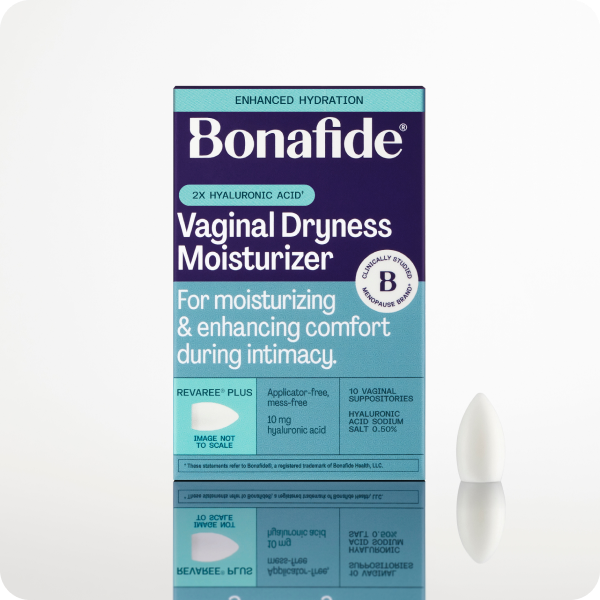
Bonafide’s product, Revaree Plus, for example, is described in its Food and Drug Administration (FDA) filing as a personal lubricant for vaginal application, intended to moisturize and lubricate to support comfort during intimacy and to supplement the body's natural lubrication. The filing also notes Revaree Plus is formulated with hyaluronic acid, sweet almond oil, and glycerides, and isn't compatible with natural rubber latex, polyurethane, or polyisoprene condoms.3S
This type of specific, documented intended use is different from a general marketing claim, and it can give you a clearer sense of whether a product is designed to provide occasional lubrication, ongoing moisture, or both.
2. How is the Product Regulated?
Not every intimate care product goes through the same level of regulatory review, so it can be worth understanding where a given product falls.
In the United States, some vaginal moisturizers are regulated by the FDA as medical devices, which means the manufacturer, prior to marketing the product, submitted what's called a 510(k) premarket notification — a filing intended to show the product is "substantially equivalent" in safety and effectiveness to another legally marketed device.4
A cosmetic product, by contrast, doesn't go through this same clearance process. So, checking which regulatory category a product is placed in can be more informative than a word like "clinical" appearing somewhere on the label.
3. Can the Product's Regulatory Status be Verified Publicly?
A claim of FDA clearance is really only reassuring if you can check it yourself. The FDA maintains a public, searchable 510(k) database where anyone can look up a device by name or applicant.5
For example, in the DFA database, Revaree Plus’ 510(k) filing identifies it as a vaginal suppository, assigned filing #K213220, with an FDA decision date of June 21, 2022.6
If a company can't point you toward a verifiable public record, that may be worth factoring into your decision when choosing a vaginal moisturizer.
4. What Product-Specific Testing is Documented?
A regulatory clearance is more meaningful when you can see what testing supported it.
Revaree Plus’ FDA filing, for instance, documents biocompatibility testing conducted according to international standards, including evaluations for cytotoxicity, skin sensitization, vaginal irritation, and acute systemic toxicity. The filing states that results showed the product to be "non-cytotoxic, non-irritating, non-sensitizing, and not systemically toxic." It also documents a 24-month shelf life, based on real-time and accelerated aging studies confirming the product maintains its specifications over that period.7
Looking for this level of documented, product-specific testing — rather than general claims about an ingredient like hyaluronic acid — can help you judge whether a product's safety profile is backed by more than a marketing statement.
5. Are the Manufacturer, Directions, Warnings, and Reporting Process Clear?
Finally, a trustworthy intimate care product should make it easy to find out who makes it, how to use it, and what to do if something goes wrong. FDA clearance comes with ongoing obligations for manufacturers, including registration, listing, and labeling requirements meant to keep instructions and warnings truthful and not misleading.8
On the reporting side, the FDA operates MedWatch, a program that allows consumers and patients — not just healthcare providers — to voluntarily report a side effect, quality issue, or labeling problem with a medical device, either online9 or by phone.10
A product backed by a manufacturer that's easy to identify, with directions and warnings you can find and a documented process for reporting concerns, tends to reflect a more accountable approach to your vaginal health products.
A More Informed Way to Shop
Choosing a vaginal dryness management option doesn't have to mean guessing based on packaging claims. When you know what to look for — a clearly stated intended use, an identifiable regulatory pathway, a public record you can verify, documented product-specific testing, and clear manufacturer and reporting information — you're better equipped to make a choice that fits your body and your comfort level.
Resources
- https://www.ncbi.nlm.nih.gov/books/NBK559297/
- https://pmc.ncbi.nlm.nih.gov/articles/PMC11469619/
- https://www.accessdata.fda.gov/cdrh_docs/pdf21/K213220.pdf
- https://www.fda.gov/medical-devices/premarket-submissions-selecting-and-preparing-correct-submission/premarket-notification-510k
- https://www.accessdata.fda.gov/scripts/cdrh/cfdocs/cfpmn/pmn.cfm
- https://www.accessdata.fda.gov/cdrh_docs/pdf21/K213220.pdf
- https://www.accessdata.fda.gov/cdrh_docs/pdf21/K213220.pdf
- https://www.accessdata.fda.gov/cdrh_docs/pdf21/K213220.pdf
- https://www.accessdata.fda.gov/scripts/medwatch/
- https://www.fda.gov/medical-devices/medical-device-safety/medical-device-reporting-mdr-how-report-medical-device-problems