
If you've compared vaginal moisturizer ingredients side by side, you've probably noticed that some list "hyaluronic acid," while others list "sodium hyaluronate," and wondered whether the difference actually matters.
When it comes to sodium hyaluronate vs. hyaluronic acid, the short answer is that these two ingredients are closely related but are not considered to be identical. Keep reading to learn more about how hyaluronic acid vs. sodium hyaluronate compares, and what this comparison may mean for your menopause vaginal dryness management routine.
What are Hyaluronic Acid and Sodium Hyaluronate?
Hyaluronic acid is a naturally occurring molecule that's part of the body's skin, joints, and other connective tissue, where it helps tissue retain water and stay flexible. Alternatively, sodium hyaluronate is the sodium salt form of hyaluronic acid, and research suggests this is the molecular form hyaluronic acid takes naturally in the body.1
This means the two ingredients come from the same underlying molecule, and a product labeled with either name is drawing on very similar chemistry.
This distinction matters for anyone researching hyaluronic acid for supporting vaginal health, since genitourinary syndrome of menopause (GSM) is often a reason women look into these ingredients in the first place. GSM refers to vaginal and urinary changes linked to declining estrogen during the menopause transition, and vaginal dryness is one of its more common symptoms.2
At-a-Glance: Sodium Hyaluronate vs. Hyaluronic Acid
The table below summarizes how hyaluronic acid and sodium hyaluronate compare across the factors that matter most when evaluating a vaginal moisturizer. 3, 4, 5, 6
|
Factor |
Hyaluronic Acid |
Sodium Hyaluronate |
|
What It Is |
A natural, sugar-based, water-binding molecule found throughout the body's skin, joints, and connective tissue |
The sodium salt form of hyaluronic acid; how the molecule commonly occurs naturally in the human body |
|
Molecular Characteristics |
Same core repeating sugar-chain structure; manufactured across a range of weights, from low (10–250 kDa) to high (1,000+ kDa) * |
Manufactured across a similarly wide range — 80.2 to 4,010 kDa, per the Food Chemicals Codex**; the same repeating structure as hyaluronic acid, differing by a sodium atom in place of a hydrogen atom |
|
Moisture Retention |
Attracts and holds onto water molecules along its chain; higher-molecular-weight forms hold more water but stay closer to the surface |
No distinct difference in moisture retention in the mechanism reported |
|
Formulation Behavior |
Used in serums, gels, and moisturizers, including in its higher-molecular-weight, surface-forming state |
Also used in serums, fillers, gels, and moisturizers |
|
Relevance to Vaginal Moisturizers |
The specific form studied in clinical trials evaluating vaginal moisturizers for GSM-related dryness |
Chemically, is a very similar active ingredient studied in trials, in its naturally occurring salt form |
|
* kilodaltons (kDa): a unit describing molecule size — the higher the number, the larger the molecule ** Food Chemicals Codex: an industry reference guide for ingredient quality standards |
||
How Their Molecular Characteristics Compare
Hyaluronic acid's effects can vary significantly depending on its molecular weight. Research classifies it into low-molecular-weight (10 to 250 kDa*), medium-molecular-weight (250 to 1,000 kDa), and high-molecular-weight (1,000 kDa and above) categories, and each tends to behave differently once applied.7
Higher-molecular-weight hyaluronic acid tends to stay on the skin's surface, where it can form a protective layer, while lower-molecular-weight forms can penetrate more deeply into tissues.8
Sodium hyaluronate is manufactured across a similarly wide range — the Food Chemicals Codex** reports its molecular weight can vary from 80.2 to 4,010 kDa, according to the Cosmetic Ingredient Review's Expert Panel for Cosmetic Ingredient Safety (CIR Panel). The review also shows the two ingredients share the same repeating chemical structure, except for one position: hyaluronic acid has a hydrogen atom, while sodium hyaluronate has a sodium atom instead.9
What the Research Says About Moisture Retention
Hyaluronic acid can retain moisture because its molecular structure has many points that act like tiny magnets for water molecules, enabling it hold onto a significant amount of water.10
What This Means for Vaginal Moisturizer Ingredients
When it comes to sodium hyaluronate vaginal dryness relief and hyaluronic acid vaginal dryness relief, meaningful differences can come down to molecular weight and formulation, not the acid-versus-salt distinction, as suggested by a 2024 randomized pilot trial published in the journal Menopause.11
The trial compared a hyaluronic acid vaginal suppository with vaginal estrogen cream over 12 weeks in women with GSM. The trial found no meaningful difference in symptom scores between the two approaches, though the study it was small (49 participants), and more research is likely needed to confirm these findings.12
Does 'Sodium' in Sodium Hyaluronate Mean the Product Contains Salt?
No, despite the name, sodium hyaluronate is a chemistry term, not a sign that a product contains dietary salt. That's important to know, especially for those with health conditions like diabetes or high blood pressure.
Sodium hyaluronate is the same molecule as hyaluronic acid, but with a sodium ion in place of a single hydrogen atom13 — the sodium is a tiny piece attached to a massive molecule.
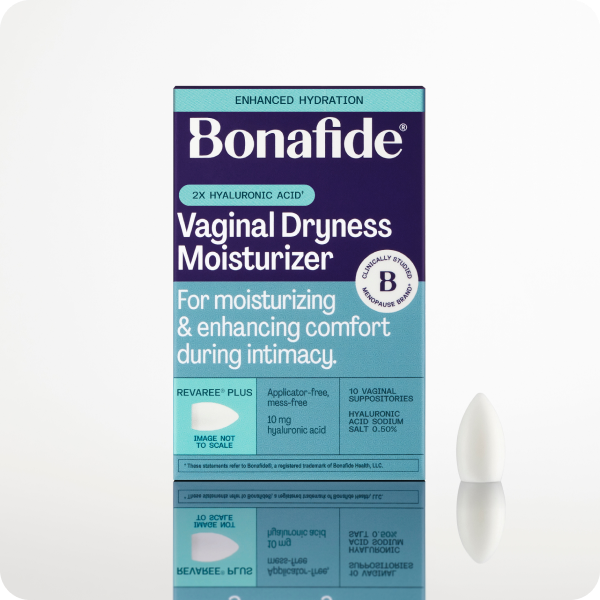
For example, Revaree contains 5 mg of hyaluronic acid sodium salt in each suppository14– the chemical equivalent to sodium hyaluronate. 15 Based on its molecular structure, sodium makes up only a small fraction of the molecule's total weight, working out to roughly 0.29 mg per suppository. But your body might not even absorb that much, as the product is applied locally, with minimal systemic absorption.
The CIR Panel backs this up, noting that ingredients of this size and weight aren't expected to meaningfully absorb into tissue, and a vaginal suppository is applied locally rather than taken systemically. The same review, which examines toxicity, reproductive effects, and genotoxicity (effects on genetic material) data for sodium hyaluronate, doesn't identify hypertension or diabetes as a safety concern.16
Additionally, FDA-reviewed topical sodium hyaluronate products don't list hypertension or diabetes as a contraindication. Revaree's labeling only lists hypersensitivity.
And when you consider the FDA's Daily Value reference for sodium is less than 2,300 mg per day,17 you'll find a single suppository contains about 0.013% of that daily reference amount — less than a single drop of soy sauce, and unlikely to be a dietary sodium concern.
None of this replaces guidance from your healthcare provider, especially if you have specific health concerns or symptoms, but the amount of sodium in a hyaluronic acid vaginal moisturizer like Revaree isn't a meaningful source of dietary sodium.
Choosing a Hyaluronic Acid or Sodium Hyaluronate Vaginal Moisturizer
If you're comparing hyaluronic acid vaginal moisturizer and sodium hyaluronate vaginal moisturizer options, it can help to remember that these two ingredients are close chemical relatives rather than competing formulas. Understanding hyaluronic acid research and how molecular weight affects a product's behavior can help you make a more informed choice, alongside guidance from your healthcare provider.
If vaginal dryness continues to affect your comfort, Bonafide’s Revaree and Revaree Plus are formulated with hyaluronic acid sodium salt, which is again the chemical equivalent of sodium hyaluronate, and may be worth exploring as part of that conversation.
* kilodaltons (kDa): a unit describing molecule size — the higher the number, the larger the molecule
** Food Chemicals Codex: an industry reference guide for ingredient quality standards
Resources
- https://www.mdpi.com/2310-2861/11/4/281
- https://www.ncbi.nlm.nih.gov/books/NBK559297/
- https://www.mdpi.com/2310-2861/11/4/281
- https://www.ncbi.nlm.nih.gov/books/NBK559297/
- https://pmc.ncbi.nlm.nih.gov/articles/PMC11469619/
- https://www.cir-safety.org/sites/default/files/SLR_HyaluronicAcid_092022.pdf
- https://www.mdpi.com/2310-2861/11/4/281
- https://www.mdpi.com/2310-2861/11/4/281
- https://www.cir-safety.org/sites/default/files/SLR_HyaluronicAcid_092022.pdf
- https://www.mdpi.com/2310-2861/11/4/281
- https://pmc.ncbi.nlm.nih.gov/articles/PMC11469619/
- https://pmc.ncbi.nlm.nih.gov/articles/PMC11469619/
- https://www.cir-safety.org/sites/default/files/SLR_HyaluronicAcid_092022.pdf
- https://cdn.clinicaltrials.gov/large-docs/75/NCT04544475/Prot_SAP_000.pdf
- https://www.fda.gov/media/152869/download
- https://www.cir-safety.org/sites/default/files/FR_Hyaluronates_062023.pdf
- https://www.fda.gov/food/nutrition-education-resources-materials/sodium-your-diet